TL;DR: A GTM engineer builds and owns the code, data pipelines, and integrations that revenue teams depend on. The role differs from RevOps, which manages process and configuration on top of that infrastructure. Job postings grew 205% in 2025, and salaries of $132K to $241K reflect a structural shift in how B2B SaaS scales revenue. Hire when data volume, integration complexity, and custom logic exceed what no-code tools handle reliably. This article defines the role, compares it to RevOps, and provides a hiring framework.
GTM engineer job postings grew 205% between 2024 and 2025, rising from roughly 1,400 open roles in mid-2025 to over 3,000 by January 2026, according to Bloomberry's analysis of 1,000 postings. That growth signals a structural change in how B2B SaaS companies build the infrastructure behind their revenue operations.
The role emerged because revenue operations scaled past what no-code tools and manual configuration can support. Companies that hire GTM engineers are making a build-versus-buy decision about their commercial infrastructure.
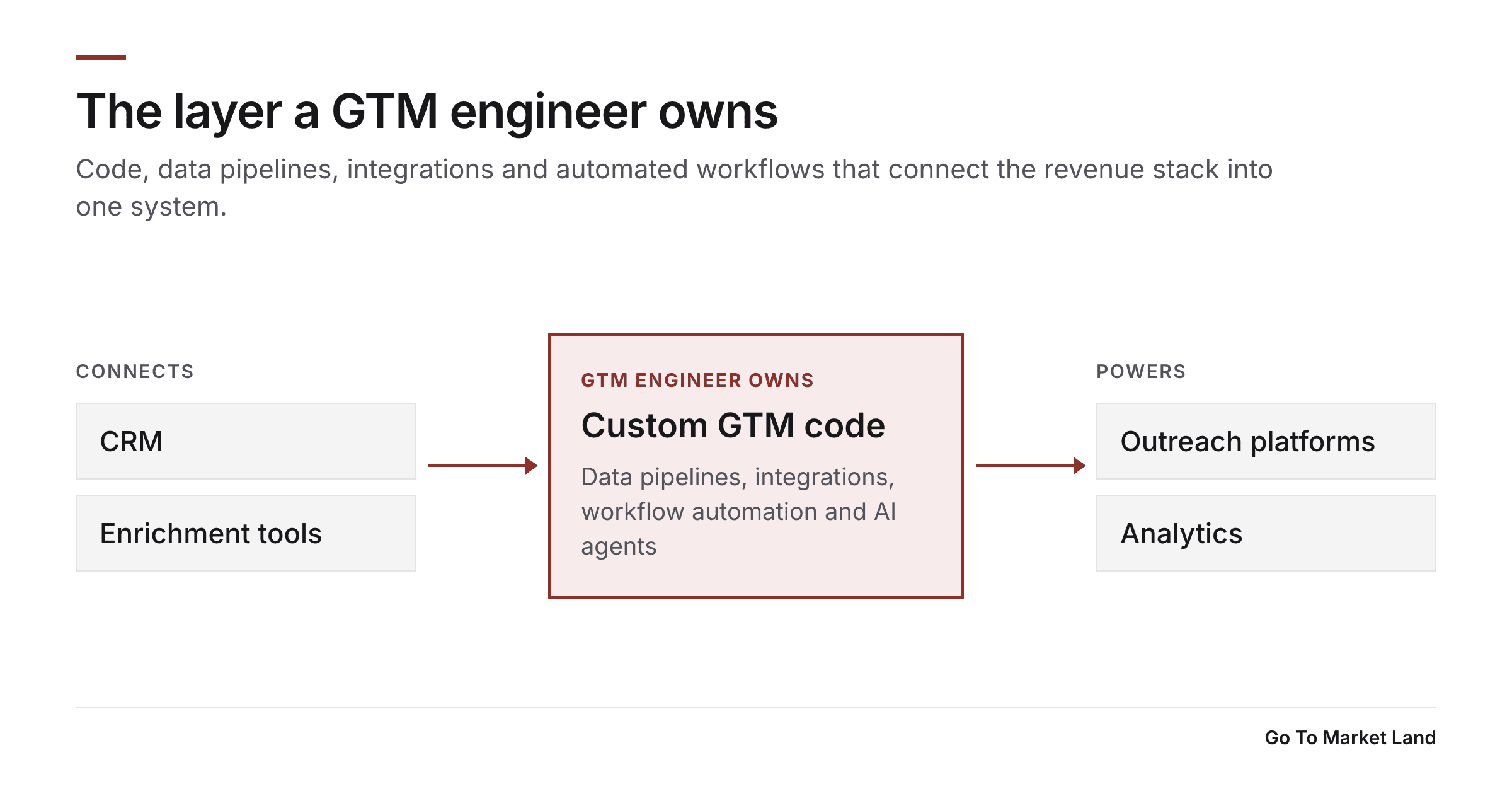
A GTM engineer is a technical go-to-market professional who designs, builds, and maintains the code, data pipelines, integrations, and automated workflows that connect a company's CRM, enrichment tools, outreach platforms, and analytics into a unified revenue system. The role sits at the intersection of software engineering and revenue operations, replacing manual processes with scalable infrastructure.
Measuring the business impact of GTM engineers
According to the 2026 State of GTM Engineering report, companies with dedicated GTM engineering functions report 2.4x faster pipeline velocity than those relying on manual operations alone. Named examples add specificity:
- Verkada: The team automated SDR workflows and generated personalized landing pages for ABM campaigns, with SDRs booking 80 to 100 meetings per month, a fourfold improvement over manual methods.
- Coastal Recruiting: Achieved 4.7x accepted intros per month within four months using GTM engineering systems.
- Antimetal: Generated 17 automated outbound deals and $2.57M in pipeline from a signal-based system built and handed over from December 2025 to May 2026, per OneGTM's case study.
GTM engineering teams also achieved three times faster experiment velocity, prototyping new processes in days instead of weeks.
Defining the GTM engineer scope
A GTM engineer owns the data pipelines, workflow automation, AI agents, and system integrations that connect enrichment, qualification, routing, and outreach into a single scalable system. The scope is technical: this person writes code, builds API integrations, deploys automations, and connects the tech stack so leads move through the funnel without manual intervention. The scope does not include campaign execution, content creation, or direct selling. The GTM engineer builds the machine. Other teams operate it.
Reporting lines for GTM engineers
Most GTM engineers report within revenue operations, typically under a VP of RevOps or a GTM Technology leader, according to ZoomInfo's analysis. At scale, GTM engineering becomes a standalone function reporting to the CRO or VP of Revenue Operations, owning the full GTM infrastructure layer. The organizational seat signals the mandate: build systems versus govern processes.
Drivers of the GTM engineering shift
Three forces pushed the GTM engineer role from experiment to standard practice.
- No-code scaling limits: No-code platforms check triggers periodically rather than in real-time, creating delays in routing and response, and they struggle with error handling and API rate limits at volume, per Baytech Consulting's analysis.
- AI adoption in revenue workflows: The role emerged because AI adoption in GTM workflows accelerated, and someone needed to govern, implement, and measure these systems, per Oren Greenberg's analysis.
- Economics of manual labor: Hiring more SDRs to compensate for operational inefficiency costs $80K to $120K per head, while building automation that eliminates 60% to 80% of manual tasks costs a fraction of that and scales without adding headcount, per SyncGTM's analysis.
The shift from "should we hire a GTM engineer?" to "how many do we need?" mirrors the DevOps trajectory from 2014 to 2018, according to GTM Pulse's career analysis.
GTM engineering vs RevOps: defining the divide
The distinction between GTM engineering and RevOps is not a matter of seniority or title inflation. These are different jobs with different outputs, skill requirements, and success metrics.
| Dimension | GTM Engineer | RevOps |
|---|---|---|
| Primary output | Code, integrations, automated systems | Process design, configuration, reporting |
| System ownership | Owns the system of action | Owns the system of record |
| Core focus | Builds net-new revenue infrastructure | Governs and optimizes existing operations |
| Typical background | Software engineering, data engineering | Operations, business analysis, CRM administration |
| Success metric | Pipeline velocity, system uptime, automation coverage | Forecast accuracy, CRM hygiene, adoption rates |
For a broader view of how technology decisions shape revenue operations, see GTML's AI and technology coverage.
Defining GTM engineer system governance
GTM engineers own the system of action: the automated workflows, data pipelines, and custom integrations that move leads, enrich contacts, route opportunities, and trigger outreach. RevOps owns the system of record: the CRM, reporting layer, and process documentation, according to Landbase's comparison.
This distinction matters because subordinating the build function to the run function stops the build function from building anything, per Salesforge's analysis. When a GTM engineer reports to someone whose success metric is forecast accuracy, engineering work takes a back seat to process maintenance.
Core goals of a GTM engineer
A GTM engineer's goals center on infrastructure outcomes:
- Diagnose systemic revenue leaks: Identify where data quality, routing logic, or integration failures cause pipeline loss.
- Build automated workflows: Replace manual list building, enrichment, and outreach with code-driven systems that scale without headcount.
- Verify fixes against acceptance criteria: Test each system change against measurable outcomes before deploying to production.
The role is fundamentally an R&D function for revenue operations. That framing sets expectations for management style, success metrics, and reporting structure.
Optimizing revenue systems via GTM engineering
GTM engineers optimize revenue systems by replacing manual, error-prone workflows with automated, testable infrastructure. The work spans four core areas: workflow automation, data unification, tech stack scaling, and custom application development. A GTM engineer builds the enrichment pipelines that surface the right accounts, the qualification logic that prioritizes them, the workflows that route them to the right people, and the AI agents that generate relevant outreach.
The first priority is building enrichment and lead-routing workflows that score, clean, and assign inbound leads to the right rep in seconds. These workflows connect the CRM to marketing automation, outbound tools, and product analytics so data flows between systems without manual intervention, per Amplify's analysis.
Most revenue stacks accumulate data silos because each tool stores its own version of the customer record. A GTM engineer connects these systems through API integrations and custom ETL processes that pull raw data from enrichment sources, apply qualification and routing logic, and feed standardized outputs into the CRM system of record. This unification eliminates the problem of marketing, sales, and customer success teams working from different versions of the truth.
The average B2B SaaS revenue stack includes a CRM, an enrichment platform, an outreach tool, a marketing automation system, and a product analytics layer. Each tool generates data, but the connections between them degrade as vendors update APIs, teams add point solutions, and manual workarounds accumulate. GTM engineers maintain these connections as production infrastructure. When commercial tools cannot handle a company's specific routing logic, scoring model, or data transformation, GTM engineers build custom applications: internal dashboards for pipeline health, custom scoring engines that weight signals commercial tools ignore, or AI-powered enrichment pipelines that combine multiple data sources.
For executives evaluating how these systems fit into a broader technology strategy, GTML's platforms and vendors coverage provides ongoing analysis of the tools GTM engineers work with.
Essential DNA of a high-impact GTM engineer
The skill profile combines software engineering fundamentals with deep knowledge of revenue systems. The role requires someone who can write production code and also understands how a sales pipeline works, what a qualified lead looks like, and why attribution models matter.
The best GTM engineers are revenue strategists who build systems, not tool administrators who stitch APIs together, per Oren Greenberg's analysis. You need someone who can diagnose a revenue problem, not just someone who can connect two APIs.
Technical foundations for GTM engineers
GTM engineers typically work in Python and SQL, with JavaScript for front-end integrations and webhooks. Python handles data processing, API calls, and automation scripts. SQL manages data transformation and reporting queries against the CRM and data warehouse. The specific language matters less than the ability to write maintainable, tested code.
The technical core of the role is API integration: connecting tools that were not designed to work together and maintaining those connections as vendors update their platforms. This requires fluency in REST APIs, webhook management, authentication protocols, and error handling. A GTM engineer needs to understand the data model of each system in the stack well enough to map fields between systems accurately. For an overview of integration patterns, Manual Focus Marketing's GTM automation guide demonstrates practical workflows.
Optimizing revenue data architecture
GTM engineers design the data flow between systems: which tool is the source of truth for each data element, how deduplication logic works, how enrichment cascades from one provider to another, and how the CRM receives standardized, clean records. Poor data architecture creates the system debt that slows pipeline velocity and corrupts reporting.
Driving value from GTM infrastructure
The value of a GTM engineer is measured in outcomes, not outputs. The question is not how many integrations they built but how much faster the pipeline moves, how much cleaner the data is, and how many manual hours they eliminated. Executives should evaluate GTM engineering hires against revenue metrics: pipeline velocity, conversion rates, data accuracy, and cost per qualified lead.
Why GTM engineering accelerates commercial velocity
Commercial velocity measures how quickly a company converts prospects into paying customers. The 2.4x pipeline velocity advantage reported by companies with dedicated GTM engineering functions reflects the cumulative effect of automation across every stage of the revenue funnel. For executives tracking these technology shifts, GTML's industry news coverage reports on how companies are restructuring revenue operations.
Bridging gaps in no-code workflows
No-code platforms like Zapier work well for simple, linear automations. They fail when workflows require conditional logic, error handling, real-time triggers, or high-volume processing. The accumulated technical debt from dozens of interconnected workflows that are difficult to version, test, and document becomes a liability when a flow fails and nobody understands the logic. GTM engineers replace these fragile connections with production-grade code that includes error handling, logging, monitoring, and documentation.
Calculating ROI on custom GTM systems
The ROI calculation compares the cost of the engineer against the cost of the manual work they eliminate and the revenue impact of the systems they build. The calculation improves further when you account for the revenue lift from faster lead response times and higher data quality.
Fixing broken data and pipeline reliability
When enrichment tools return inconsistent formats, when CRM fields go unpopulated because an integration failed silently, when lead routing assigns prospects to the wrong rep, the pipeline suffers. GTM engineers build monitoring and alerting into every system, so failures surface immediately rather than festering for weeks.
Accelerating GTM response times
When a prospect fills out a form, the difference between a five-minute response and a five-hour response can determine whether the deal closes. GTM engineers build real-time routing systems that score, enrich, and assign inbound leads to the right rep in seconds. This speed advantage compounds across every inbound lead, every outbound campaign, and every product-qualified signal.
Trigger points for your first GTM engineer hire
The decision to hire a GTM engineer should be driven by specific, measurable signals. Most companies hire their first full-time GTM engineer between $5 million and $10 million ARR. Beyond revenue, the operational triggers include:
- Team size: You have more than 5 sales reps. Below that, manual maintenance is cheaper than a system.
- Campaign complexity: You run 3 or more concurrent campaigns.
- Tooling spend: Your tooling costs exceed $3,000 per month.
- System failures: Something broke and nobody noticed for a week.
For executives evaluating broader organizational changes, GTML's industry news category tracks how companies are restructuring their revenue teams.
Scaling revenue via GTM engineering
Companies that experimented with one GTM engineer in 2023 are building teams of 3 to 5 in 2025. That shift from novelty hire to core function indicates that the role scales with revenue complexity. If your business generates less than $1 million in ARR, focus on manual sales execution first.
How GTM engineers clear system debt
System debt accumulates when teams build workarounds on top of workarounds: a Zapier automation that a contractor built two years ago, a Google Sheet that someone manually updates every Monday, a lead scoring model in a spreadsheet that only one person understands. GTM engineers clear this debt by rebuilding systems from scratch: diagnosing systemic revenue leaks, building automated workflows across the stack, and verifying each fix against acceptance criteria. This rebuild function differs from RevOps maintenance because it starts with a blank canvas rather than optimizing within existing constraints.
Buy vs build tradeoffs for GTM teams
Agencies can build the first GTM system faster than a new hire, and many startups outsource the initial build and bring ownership in-house once proven. That approach avoids hiring a full-time engineer for an unproven motion and avoids running an agency forever on internal IP. The trade-off: custom applications built internally allow for solutions that match a company's specific revenue processes, but they require ongoing maintenance and may take longer to implement than commercial software.
| Trigger condition | Recommended action | Rationale |
|---|---|---|
| Under $1M ARR, manual processes work | Focus on manual execution | Premature complexity without ROI |
| $3M-$10M ARR, 5+ reps, tooling over $3K/month | Hire first GTM engineer | Manual maintenance costs exceed system cost |
| Scaling past $10M ARR, multiple campaigns | Build GTM engineering team | Single engineer becomes bottleneck |
| Unproven motion, need speed | Outsource to agency, then hire | Validate before committing headcount |
Staffing for data driven growth
The organizational model depends on company stage. Between $3M and $15M ARR, companies typically split the roles organically: one RevOps person who defines, governs, and measures, and one GTM engineer who builds, automates, and integrates. Both report to a Head of RevOps or VP Operations. At larger scale, GTM engineering becomes a standalone function with its own team and reporting line to the CRO.
How GTM engineering accelerates revenue velocity
Revenue velocity measures how quickly a company converts prospects into paying customers. GTM engineering accelerates this by removing manual bottlenecks, improving data quality, and enabling faster experimentation across the entire funnel. The named outcomes above illustrate the pattern: Verkada's SDR team quadrupled meeting volume, Coastal Recruiting achieved 4.7x accepted intros, and Antimetal generated $2.57M in pipeline from automated systems. These results share a common mechanism: replacing manual, inconsistent processes with automated, reliable systems.
Optimizing funnel speed and yield
GTM engineers improve funnel speed by automating the steps that slow down lead progression: manual enrichment, list building, lead scoring, and routing. Each automated step reduces the time a lead spends waiting for human action. The yield improvement comes from better data quality: when every lead is enriched, scored, and routed correctly, fewer qualified prospects slip through the cracks. If leads are slipping through the cracks, your attribution is unreliable, and no one owns the systems, that is the moment a GTM engineer pays for themselves.
Optimizing rep productivity at scale
Sales reps spend a significant portion of their time on non-selling activities: building lists, researching prospects, copying data between tools, and updating CRM records. GTM engineers automate these tasks, freeing reps to focus on conversations with buyers. The productivity gain compounds as the team grows: automation that saves each rep two hours per day scales linearly with headcount, while the engineer who built the system does not.
Ensuring data integrity for GTM systems
Data integrity determines whether revenue teams can trust their own reporting. GTM engineers build data validation, deduplication logic, and enrichment cascades that maintain clean records as volume scales. They also build monitoring systems that flag anomalies: a sudden drop in enrichment match rates, a spike in bounced emails, or a routing rule that starts assigning leads to inactive reps. These systems protect the data foundation that forecasting, attribution, and territory planning depend on.
Measuring GTM engineering performance
GTM engineering performance should be measured against business outcomes, not technical outputs. The metrics that matter include pipeline velocity (time from first touch to qualified opportunity), data accuracy (percentage of CRM records that are complete and current), automation coverage (percentage of manual tasks that have been automated), and system uptime (percentage of time that integrations and workflows run without failure). Executives should set quarterly targets for these metrics and review them alongside traditional revenue KPIs.
If you have first-hand experience building or hiring for a GTM engineering function, share your source material or contribution ideas through gotomarketland.com/contribute.
FAQs
Is a GTM engineer the same as a sales engineer?
No. A sales engineer supports the sales process by demonstrating technical product capabilities to prospects. A GTM engineer builds internal revenue infrastructure: data pipelines, integrations, and automated workflows that the sales team uses.
What's the typical salary range for a GTM engineer?
Total compensation for GTM engineers in the US ranges from $132,000 to $241,000, with a median of $176,000, according to Apollo's salary analysis. Early-stage startups often offer lower base salaries ($110K to $140K) with meaningful equity, while public companies pay higher base compensation ($150K to $200K) with smaller equity grants.
Can RevOps teams function without a GTM engineer?
Yes, below $5M ARR and with straightforward tech stacks. The need for a GTM engineer emerges when data volume, integration complexity, or custom logic requirements exceed what no-code platforms handle reliably.
How many GTM engineers does a company need?
Most companies start with one GTM engineer between $5M and $10M ARR. Companies that hired one in 2023 are building teams of 3 to 5 by 2025.
Should a GTM engineer report to engineering or revenue operations?
Most GTM engineers report within revenue operations, typically under a VP of RevOps or GTM Technology leader. At scale, the function reports to the CRO or VP of Revenue Operations as a standalone team.
Key terms glossary
- System debt: The accumulated cost of manual workarounds, undocumented integrations, and fragile automations that slow down revenue operations over time.
- System of action: The automated workflows, pipelines, and integrations that actively move leads and data through the revenue funnel. GTM engineers own this layer.
- System of record: The CRM and reporting infrastructure that stores the authoritative version of customer and pipeline data. RevOps owns this layer.
- Pipeline velocity: The speed at which prospects move from first touch through qualified opportunity to closed deal, measured in days or weeks.
- ETL (extract, transform, load): A data integration process that pulls data from source systems, standardizes it, and loads it into a destination system such as a CRM or data warehouse.