TL;DR: Early-stage B2B startups burn runway when they scale GTM spend before validating the motion. This playbook gives you a six-step decision sequence: define your market entry point, choose a motion that matches your unit economics, craft a narrative for the buying committee, map outreach to buyer intent, design a sales engine that converts, and track leading indicators. Each step includes the evidence you need before committing the next dollar.
Most startups fail because they scale GTM spend before validating the motion. They hire reps, spend on demand generation, and build pipeline before the motion repeats. The fix is a sequence that validates before it commits.
This playbook breaks a go to market strategy for startups into six decision steps, each with the evidence you need before moving forward. The framework works whether you're a founder acting as the de facto GTM lead or a newly hired CRO building the commercial function from scratch.
Scaling GTM: From Initial Fit to Repeatable Play
Optimizing spend for early GTM success
Every dollar spent before validation is a dollar you can't spend after. Separate your budget into validation spend (interviews, founder-led outreach, small-scale tests) and scaling spend (hiring, demand generation, technology). Validation spend should be small, fast, and tied to a specific question. Scaling spend should wait until the evidence says go.
Optimizing Speed for Early Validation
Founder-led sales is the fastest validation path because the founder carries product knowledge, pricing authority, and the ability to change the pitch in real time. No first rep can match that combination. The ICONIQ State of Go-to-Market 2026 report, based on data from 150+ B2B software GTM leaders, found that the companies pulling ahead are blending top-down and bottom-up GTM, rethinking monetization, and embedding AI across the funnel.
How to Prevent Scaling Blind Spots
The most common blind spot is treating lagging revenue as the only signal. By the time revenue drops, the problem is months old. Leading indicators like demo-to-conversion rate, sales cycle length, and ICP fit score tell you whether to pivot or persist before you burn meaningful runway. The six steps below build those checkpoints into the sequence.
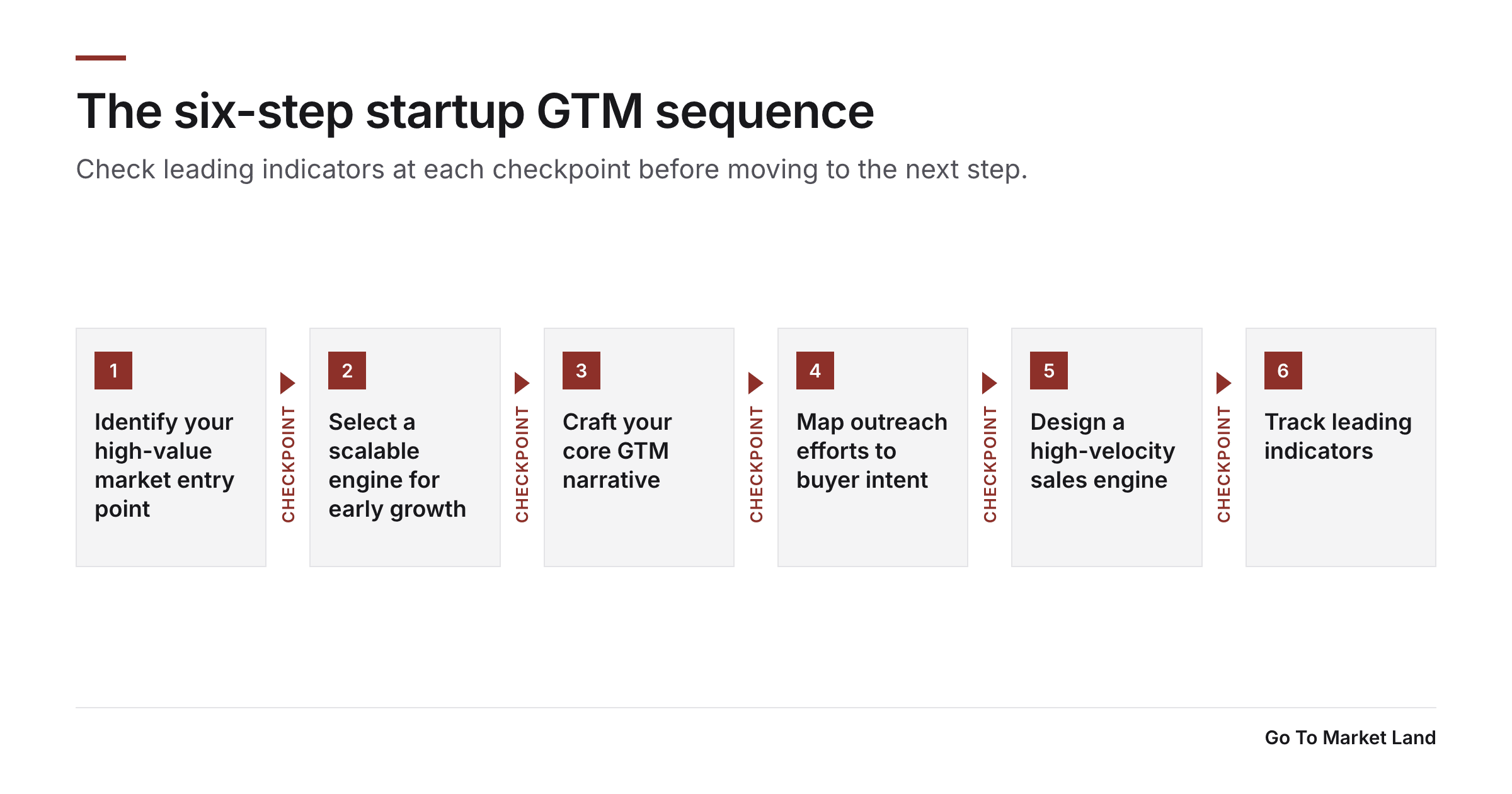
Step 1: Identify your high-value market entry point
Targeting Economic Decision Makers
The economic decision maker (EDM) holds budget authority and final approval power. Champions advocate for you, evaluators test your product, but the EDM signs. Early-stage startups should target EDMs directly because every layer between you and the signer adds time to the sales cycle. Enterprise sales cycles average 6-12 months, and complex deals over $500K ACV can run 270 days or longer according to Arcade Software research.
Assess Buyer Pain and Resolution Need
Latent pain means the buyer acknowledges a problem but has no active plan to fix it. Resolution need means they're searching for a solution now. Selling to latent pain requires education, which takes time and budget. Selling to resolution need requires proof, which you can build through pilots and early customers. Distinguish between the two before you invest in outreach.
Chart the Full Buying Committee
Map every stakeholder before your first outreach. A typical B2B buying committee includes four roles:
- EDM: Budget authority and final approval. Focus on ROI and business outcome.
- Technical evaluator: Tests functionality, integration, and compliance.
- End user: Uses the product daily. Provides feedback on usability.
- Procurement: Manages contract terms, security, and vendor requirements.
Enterprise buying committees average 6-10 stakeholders, and complex deals can involve more. Identify the three roles you must win and engage them in order.
De-risk your GTM before scaling up
Before moving to Step 2, collect three types of evidence:
- ICP interviews: At least 5 conversations with companies that match your target profile.
- Pain-point confirmations: Several prospects who confirm the pain is active and budgeted.
- Buying committee map: At least 1 complete map showing who decides, who evaluates, and who uses. If you can't produce all three, you're not ready to choose a motion.
Step 2: Select a scalable engine for early growth
Evaluating PLG Versus Sales-Led Models
The choice between product-led growth (PLG) and sales-led growth depends on unit economics: average contract value (ACV), buyer complexity, time to value, and CAC profile.
| Criterion | PLG | Sales-Led | Deciding Factor |
|---|---|---|---|
| ACV threshold | Below ~$5K/year | Above ~$50K/year | Below ~$5K makes sales-led unviable; above ~$20K makes pure PLG hard to sustain without a sales-assisted layer |
| Time to value | Minutes to days | Weeks to months | If users reach core value in one session, PLG works; if value requires migration or configuration, self-serve leaks users (LoudDemand analysis) |
| Buyer complexity | Single user or small team | Buying committee, procurement | When the buyer and user are the same person, PLG fits; when multiple stakeholders decide, sales-led is necessary |
| CAC profile | $100-500 per customer | $5K-50K per customer | If ACV is below the threshold where LTV:CAC stays above 3:1, the motion is structurally unviable |
Choose PLG when your ACV stays below ~$5K and users reach value alone in minutes. Choose sales-led when contracts run above ~$50K and committees decide.
Using Founder Sales to Validate Fit
Founder-led sales is the default first motion because it compresses the feedback loop. You hear objections directly, adjust pricing in real time, and learn which features matter before you build a sales deck.
Track response rate on outreach, meeting-to-pilot conversion, and objection pattern consistency. Seed-stage companies that close their first 5-10 deals with founders at the table develop pattern recognition: the same objections surface by deal 5, and by deal 10, discovery calls stop producing surprises. If you can't anticipate most of what a prospect will say on a first call, you don't yet have enough pattern to hand off, regardless of deal count, according to founder-led sales effectiveness research. This is the signal you have enough consistency to document a process and train a first rep.
Scaling Capacity: Hiring Your First Rep
Hire your first rep after you've closed enough deals to document a repeatable process. Look for someone who can follow a process, not just close. Your first rep's job is to replicate what works, not invent a new motion.
Operationalizing Mixed Sales Models
A hybrid PLG + sales-led model makes sense when your product has a self-serve entry point but larger deals require human help. The handoff mechanics matter: define the product usage signal that triggers a sales touch (for example, a team exceeding 5 seats or hitting a usage ceiling). The ICONIQ 2026 report found that 48% of companies now use hybrid pricing models, with consumption-based structures on the rise. That trend suggests hybrid GTM motions are becoming the default, not the exception.
Step 3: Craft Your Core GTM Narrative
Defining Your Market and Competitive Edge
Position against the status quo, not just competitors. Your real competitor in early-stage B2B is the buyer doing nothing. Use a "from X to Y" framing: "from manual spreadsheet tracking to automated pipeline visibility" names the pain and the outcome.
Value proposition for each buyer persona
Each buying committee role needs a different value proposition:
| Persona | Pain | Outcome | Proof Point |
|---|---|---|---|
| EDM | Missed revenue targets, inefficient spend | Predictable pipeline, measurable ROI | Pilot results showing conversion improvement |
| Technical evaluator | Integration risk, security gaps, maintenance burden | Clean API, SOC 2 compliance, minimal config | Technical documentation, security certifications |
| End user | Manual work, context switching, slow processes | Time savings, fewer tools, faster workflows | Usage data showing adoption and time-to-value |
Evidence Metrics for Market Entry
Before you have case studies, build a proof stack from three sources: customer quotes from pilots, usage data showing engagement depth, and internal benchmarks showing before-and-after results. Specificity matters: "reduced onboarding time from 3 weeks to 4 days" is stronger than "improved efficiency."
Step 4: Map outreach efforts to buyer intent
Testing Product Fit via Cold Sales
Cold outreach is a validation tool, not just a revenue channel. Every reply, objection, and meeting tells you something about market fit. Founder-led outreach consistently achieves 8-15% reply rates compared to 2-5% typical for SDR-led campaigns. If your reply rate is below that range, your targeting or messaging needs work before you spend more.
Matching Demand Signals to Buying Cycles
Active demand leaves signals: job postings for roles your product supports, funding announcements that create budget, technology adoption patterns that indicate readiness. Align your outreach timing to these signals instead of running always-on campaigns. A company that just hired a VP of Sales is more likely to evaluate sales tools than one that has had the same team for three years.
Optimizing Channel Partners for Scale
Channel partners make sense when they give you reach you can't build alone and when your product fits their existing customer base. The trade-off is control and margin: partners take a percentage and own the customer relationship. For early-stage startups, channel partnerships work best after you have a repeatable direct motion and need to extend reach without proportional headcount growth.
Optimizing GTM Spend for Runway
Allocate spend based on validation evidence, not best practices. Companies with well-defined GTM strategies see measurably faster profit growth and higher customer retention compared to those without formal planning. That doesn't mean you need a 50-page strategy document. It means every GTM dollar should trace to a specific validation question or scaling goal.
Step 5: Designing a high-velocity sales engine
Defining Ideal Customer Profiles
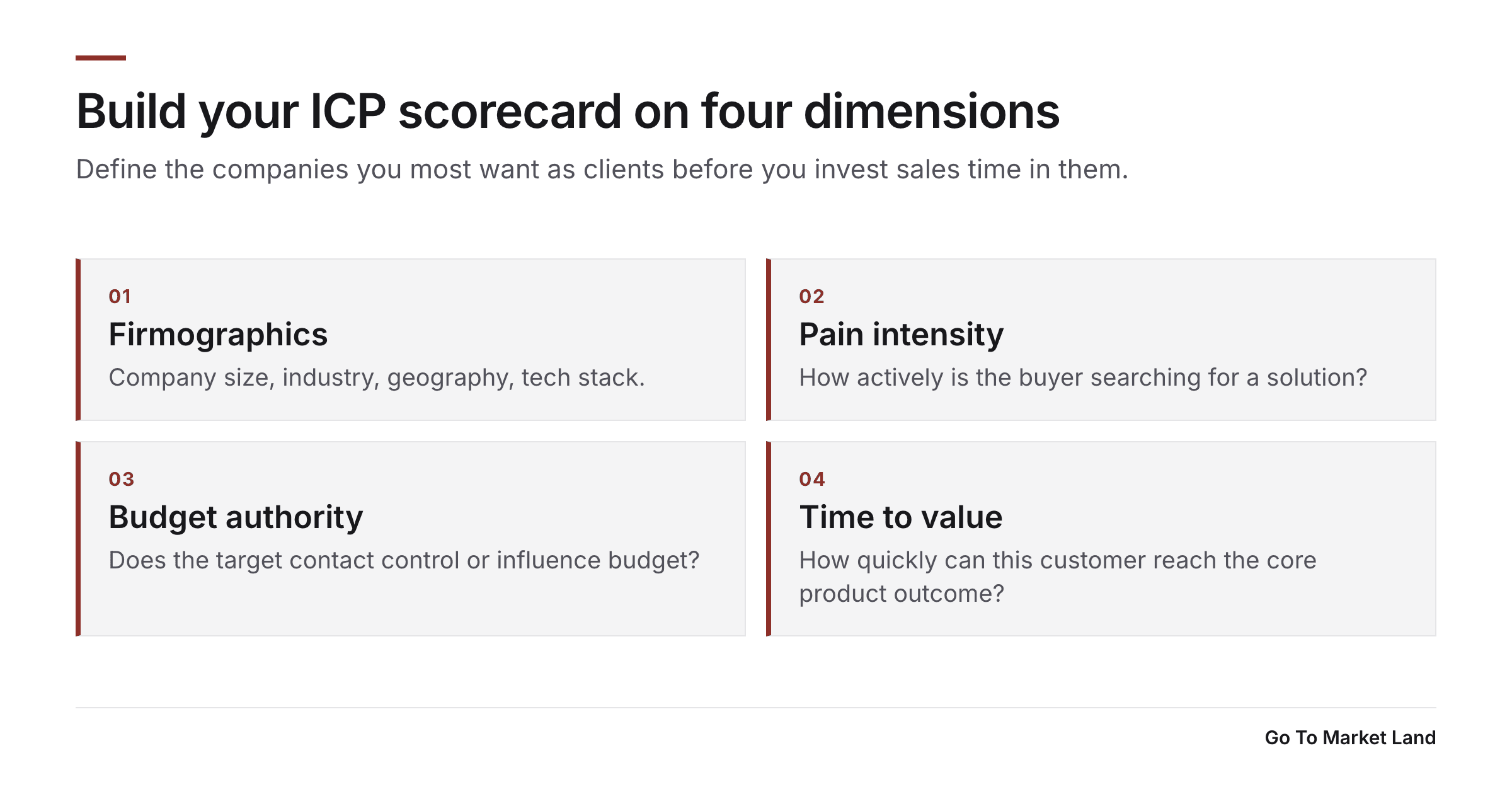
Your ideal customer profile (ICP) is a description of the companies you most want as clients, defined by firmographics, pain intensity, budget authority, and time to value. Build an ICP scorecard with four dimensions:
- Firmographics: Company size, industry, geography, tech stack.
- Pain intensity: How actively is the buyer searching for a solution?
- Budget authority: Does the target contact control or influence budget?
- Time to value: How quickly can this customer reach the core product outcome?
Companies that tighten their ICP see measurably higher win rates and shorter sales cycles. Teams implementing a well-defined ICP report sales cycles 30-60% shorter compared to non-ICP leads.
Testing Market Fit With Sales Demos
Use demos as a fit signal, not just a sales tool. Track three metrics: engagement depth (how many features the prospect explores), objection types (price, integration, timing), and follow-up rate (does the prospect respond within 48 hours?). A typical new-business win rate (opportunities that close) sits around 18-21% for sales-led motions. If your demo-to-close rate is significantly below that range, the issue is likely targeting or product fit, not sales skill.
Aligning Revenue to Buyer Value
Pricing and packaging should match the value the buyer receives. The LTV:CAC ratio (lifetime value divided by customer acquisition cost) tells you whether your growth engine is sustainable. The minimum sustainable ratio for growth-stage B2B SaaS is 3:1. Early-stage companies can operate at 1.5-2.5:1 while they optimize their funnel and retention. Seed-stage companies ($1-10M ARR) should target 2.0-3.0:1, with elite performers at 3.5:1 or higher.
Streamlining Your Commercial Agreements
Simplify contracts: use a standard MSA with a one-page order form, offer monthly billing for pilots, and cap liability at 12 months of fees.
Step 6: Track Leading Indicators for GTM Success
Pre-Revenue Signals of Market Fit
Leading indicators tell you whether the motion is working before revenue is predictable. The Starr Conspiracy benchmarks identify three core signals: MQL-to-SQL conversion rates (13-31% by motion), documented ICP frameworks (32% higher win rates), and weekly review cadence (34% better target achievement). ZoomInfo's framework adds timing: 30-day indicators show whether targeting lands, 60-day metrics show whether leads qualify, and 90-day indicators confirm unit economics.
Target conversion rates by GTM model
Conversion benchmarks vary by motion. The table below shows median ranges for PLG and sales-led funnels based on 2026 B2B SaaS funnel data:
| Funnel Stage | PLG Median | Sales-Led Median |
|---|---|---|
| Visitor to Lead | 3-9% | 0.5-1.5% |
| Lead to MQL | 45-65% | 25-40% |
| MQL to SQL | ~35-55% | ~30-45% |
| SQL to Opportunity | 45-60% | ~35-50% |
| Opportunity to Customer | ~15-30% | ~15-30% |
PLG converts more visitors but closes fewer deals. Sales-led converts fewer visitors but closes at higher rates with larger contracts. For trial-to-paid conversion, UXCam benchmarks show 8-12% as average for PLG motions.
Evaluating Signals to Pivot or Persist
Use these five decision checkpoints before committing additional resources:
| Checkpoint Question | Pivot Signal | Persist Signal |
|---|---|---|
| Is the same objection appearing in every deal? | Yes, with no written response that works | Objections vary and have documented answers |
| Is demo-to-close rate improving over the last 10 deals? | Flat or declining | Trending upward |
| Is sales cycle length shortening? | Getting longer | Getting shorter |
| Are ICP-fit deals closing faster than non-ICP deals? | No difference | ICP deals close 30-60% faster |
| Can a new rep follow your process and hit benchmarks? | No, results depend on founder | Yes, results hold without the founder |
Reducing Startup Burn via Strategic GTM Design
Aligning GTM Spend with Growth Goals
Every GTM dollar should trace to either a validation goal or a scaling goal. Validation spend answers a question ("Will this segment buy at this price?"). Scaling spend executes a proven motion ("Hire two reps to replicate the founder playbook"). The mistake is mixing the two: spending $50K on demand generation before you know which message converts is scaling spend on an unvalidated motion.
Defining Your Initial GTM Hiring Order
The hiring sequence follows the validation sequence:
- Founder-led sales: You. Until you've closed enough deals to document a repeatable process.
- First sales rep: After the playbook is stable and conversion rates hold for 90 days.
- First marketer: After you know which channels produce ICP-fit leads.
- First customer success hire: After you have enough customers to see churn patterns.
Hiring out of order (a marketer before you know your message, a CS hire before you have churn data) burns runway without reducing risk.
Optimizing the GTM Technology Stack
Adopt tools in the order you need them, not the order vendors sell them. At the validation stage, you need a CRM, a way to send and track outreach, and a way to record calls. At the scaling stage, you need routing, scoring, and reporting.
Fragmented stacks produce fragmented data, and fragmented data makes every downstream AI model, routing workflow, and forecast less reliable, according to ZoomInfo's analysis. Consolidation is the prerequisite for compounding GTM infrastructure. Highspot's research reinforces this: centralize data governance across revenue systems before any stack delivers full value.
Building a startup go to market strategy means making the right decisions in the right order, with evidence at each checkpoint. If you have first-hand experience with a seed-to-Series A GTM transition, or if you have source material that would strengthen this playbook, share it through our contribution page.
FAQs
What is a go-to-market strategy for startups?
A go-to-market strategy for startups is a sequence of decisions that defines which market segment to enter, which sales motion to use, and how to allocate limited resources to validate product-market fit before scaling spend. It covers ICP definition, motion selection, messaging, outreach, sales execution, and measurement.
When should a B2B startup build its first GTM strategy?
Build your first GTM strategy when you have a working product and are ready to acquire your first 10 customers. The strategy should be lightweight: an ICP hypothesis, a chosen motion, and 3-5 metrics to track. Refine it after every 5 customer conversations.
How much runway should I allocate to GTM validation?
Allocate enough to run 5-10 customer conversations, 2-3 pilot programs, and one channel test. For most seed-stage B2B startups, this typically means several months of founder time and roughly $3K-15K per month in direct spend. The goal is to validate the motion before committing to scaling spend.
What are the signs my startup GTM strategy is working?
Track three signals: demo-to-close rate improving over the last 10 deals, sales cycle length shortening, and ICP-fit deals closing faster than non-ICP deals. If all three are trending positive for 90 days, the motion is working and ready to scale.
Should I hire sales or marketing first in my B2B startup?
Hire sales first. A rep can replicate a validated founder playbook and generate revenue while you build marketing. Marketing hired before you know which channels convert will spend budget on unvalidated tactics.
Key terms glossary
- ICP (Ideal Customer Profile): A description of the companies you most want as clients, defined by firmographics, pain intensity, budget authority, and time to value.
- CAC (Customer Acquisition Cost): Total sales and marketing spend divided by the number of new customers acquired in a given period.
- LTV (Customer Lifetime Value): The total gross profit a customer generates over their entire relationship with your company.
- PLG (Product-Led Growth): A GTM strategy where the product itself drives customer acquisition, typically through free trials or freemium models.
- Sales-led motion: A GTM approach where salespeople run the full cycle from demo to signature, typically for higher-ACV products with buying committees.
- Buying committee: The group of stakeholders involved in a B2B purchase decision, including the economic decision maker, technical evaluator, end user, and procurement.
- Economic decision maker (EDM): The person with budget authority and final approval power in a buying decision.
- Leading indicator: A measurable signal that predicts future performance, such as demo-to-conversion rate or sales cycle length, tracked before revenue is predictable.
- Unit economics: The revenue and cost metrics per customer, including CAC, LTV, and the ratio between them, that determine whether growth is sustainable.
- Time to value: The time it takes for a new user to experience the core benefit of your product, from signup to first meaningful outcome.